
as featured in The Fetishistas magazine published April 15 2026
Patrick Whitaker and Keir Malem are a Dalston based design duo who create unique and largely one-off leather body sculptures. They started out in the late 1980s with fashion focused pieces for a few shops, but they now produced commission-led mainly one off pieces for film, red carpet and stage wear. The pair met in the mid 1980s, first forming a personal relationship and then deciding to work together . The professional collaboration began when Kier assisted Patrick with his St. Martins graduate fashion collection (1987), where the foundations of what became their signature method of moulding lethal garments were set in motion.They work as a team , both drawing and designing as well as splitting their manufacturing tasks. Keir does the the cutting and Patrick dyes the skins, develops the structural techniques and sews the garments. The themes explored in Patricks graduate collection of gladiators, mythic world creatures and Roman sculpture are evident in the body shapes of the clothing they’ve produced ever since.
The Mandrake Hotel ‘Happening”
When earlier this year, I met the duo to interview them, shortly after they celebrated 40 years of working together with a “happening” at London’s Mandrake Hotel which I attended. Patrick explains “ We embrace tailoring and cutting, like Atomise founder John Sutcliffe. We were working on the Wonder Woman movie and some guy working with us said Your stuff is not making clothes ,it is leather engineering .
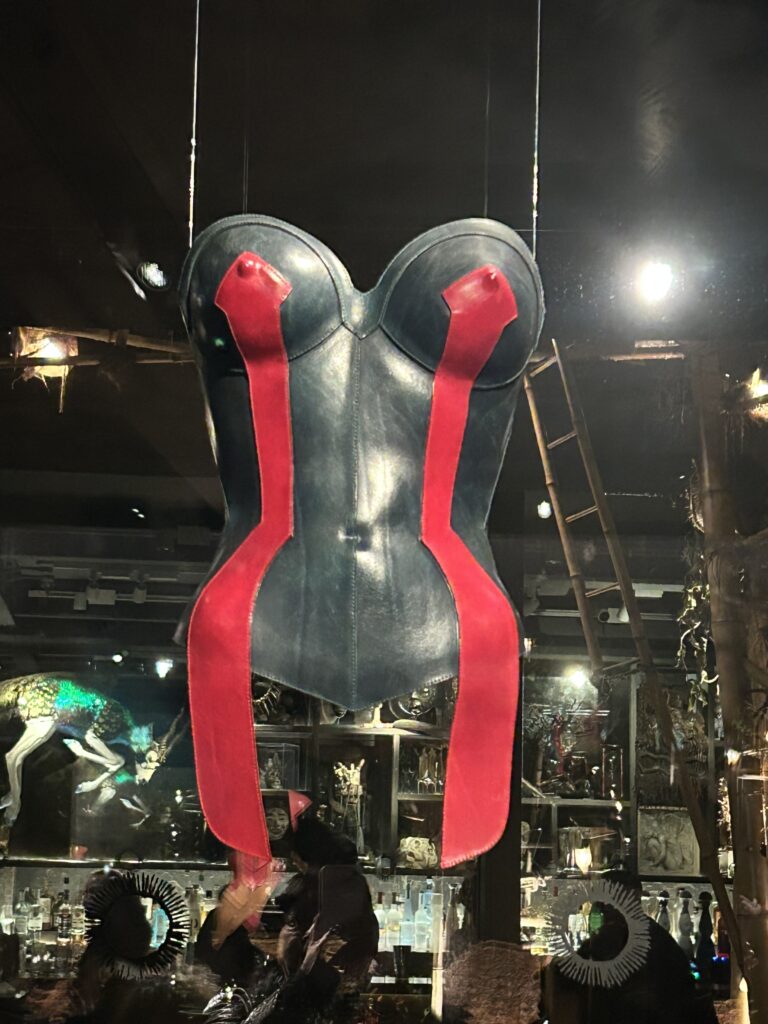
During the evenings preamble, performer Dolly Rotten , aka Rotten Babe appeared in the window of the hotel wearing a WM Body Sculpting Corset looking like a sex worker in an Amsterdam brothel, to the amusement of the arriving guests. The evening continued inside with the designers interviewed by the Mandrakes kink concierge, Sophie Cohen, in the plush surroundings of the hotels CoOc Club, with examples of their work displayed on their own mannequins adding to the decor. Sophie, wearing WM’s elaborately structured black leather waist cincher, spoke to them about their practice and philosophy, while Dolly performed throughout the evening by donning a selection of the garments adorning the room. At the end of the interview, the two designers conducted a dressing ritual, changing Dolly from a long bustier into WM’s six-piece body encasing Buckle-UP Armour, which she paraded among guests.
The venue for Whitaker Malem’s ‘happening’ was well chosen. The Mandrake has set itself up. To fuse art,culture and design through curated events like these , buy inviting performers and artists to present evening gatherings. The hotel has contemporary baroque-decorated rooms where the minibars feature not just the usual sort of items, but also a ‘couple’s fun pot’ and, in a drawer below, a selection of Lelo sex toys to purchase. This niche venue provides a forward-thinking environment that seems to be running counter to the general vibe of other establishments which are backing away from fetish or openly sex-related events.This niche venue provides a forward-thinking environment that seems to be running counter to the general vibe of other establishments which are backing away from fetish or openly sex-related events.
The Mandrake has absorbed the current Zeitgeist of the dissolution of sexual categories such as gay, straight, lesbian, to promote a transmorphic or gender-neutral environment where boundaries don’t exist.
The COOc club’s page on the Mandrake website describes the club as a ‘space designed to break boundaries, celebrating the wild and unexpected’. It illustrates this with images of top London fetish model and EctoMorph favourite Miriam Veil dressed in latex, naturally !
Patrick reveals that he and Keir knew about the Mandrake from doing a couple of shoots there, one of which was for Portuguese Vogue with [American singer and rapper] Brooke Candy. “There is an amazing penthouse with a bed that comfortably fits ten people. They do rope-tying talks — kooky events that are sex positive.
“It’s not a hetero-normative environment but is run by this great guy, Rami Fustok, as a sex positive place. The gay scene is dying — young people don’t want to just be categorised as gay.”
WM philosophy tunes into this orientation: their work questions identity and sexuality through creating idealised versions.
Updating an Old Leather-moulding technique
They developed their own technique of moulding leather into body sculpture by soaking the leather in vegetable dyes, and then wet-moulding the it onto the mannequin .Explains Patrick: “The wet moulding was an act of desperation: leather was plunged into warm water to soften it in a similar kind of method employed by potters, who in fact refer to it as making the clay leather-like. (French version of this process is cuir builli (boiled leather). It was first used in the Middle Ages to preserve the moulded shape of leather when it dried and hardened.] “To create the tension,” adds Patrick, “our process relies both on the wet moulding and the seaming; it is a random process.”
Whitaker and Malem refer to themselves as “pop artisans”, and the artisanal stitching they employ to tailor their garments around the body certainly results in a more handcrafted couture look. Their work is like no other, so is instantly recognisable. But they are adamant they are not a brand; they do not dilute their art into consumer multiples.WM have also defied the fashion norms of two collections a year, finding that process too stressful and demanding, not to mention hugely expensive. They have only shown a collection on the London Fashion Week catwalk once — in 1991.
As admirers of the legendary Thierry Mugler, they absorbed his ideas as a starting point, but then departed, establishing their own idiosyncratic leather ‘sexed body’ sculptures.This is a path taken by a lot of artists, who begin by following a school or movement and then go on to refine those ideas into their own oeuvre, until they become the leading exponents of that movement.Whitaker Malem’s ideas both follow on from the laced leather jackets Azzedine Alaïa created and extend the fibreglass breastplates created by Mugler. The latter were based on the tail fins and chrome trim of 1950s American cars, while WM express their obsessions with the mythic gladiator and are unmistakably their own
Patrick Whitaker’s mother Anne was a sculptor who taught Keir to work with fibreglass.Says Keir: “She suggested that if we wanted to display our work better, we should cast a mould.“ So their longtime friend Tilly Collins’ body was used as the template for the application of their designs.Patrick was at the time using one of Tilly’s bedrooms as his first studio. “I grew up with the smell of fibreglass and resin as my mum was always making sculpture.“She got civic commissions around Berkshire where I grew up. A piece at the front of a church in Bracknell is my mum’s, and is still there.”Progress for Keir and Patrick has led to also casting a male mould as a foundation on which to create. It is their version of ‘draping on the stand’ — a traditional fashion design method of construction.
WM may now also have their own imitators. Berlin designer Marina Hoermanseder has arrived in their wake and seems to be influenced both by the moulding techniques of WM and the latex designs of Atsuko Kudo.Marina, whose moulded creations have, since 2015, been adorning various celebs including Kylie Jenner, Naomi Campbell, Nicki Minaj and Janelle Monai, achieved headline-grabbing status at this year’s Grammys with her shiny flesh-coloured dress worn by Heidi Klum on the red carpet.This dress does not have the sculpting quality of Whitaker Malem’s work or the second skin look of Atsuko Kudo, but expresses Hoermanseder’s own creative departure.In photos it somewhat resembles a jelly-mould version that has been strapped onto Klum’s body.
Keir explains: “We love the way latex performs on the body. We always come back to an image that Allen Jones took in 1972 of actress Jenny Runacre wearing an orange catsuit.”
[Editor’s note: The following year, Jenny Runacre starred in The Final Programme, a British sci-fi movie (based on the Michael Moorcock novel of that name) for which Jones co-created the ‘transmorphic’ poster image. The photo of Jenny that Patrick refers to may have influenced Jones’ contribution to the poster art, but as far as we know, it wasn‘t shot with that purpose in mind.]
“We are obsessed by bodies — how they move, what they look like,” Keir continues. “And as lifelong naturists we feel there is nothing more interesting than the human body. That is where we started making those transmorphic things — men’s and women’s bits. “The thing I like about latex is the way it compresses the body. When you move wearing latex, it’s interesting to see what happens.”Keir adds that he thinks very large people who wear latex can create extraordinary images, rather like the “sucking-out process” of vac beds.
Cross-pollination between leather and latex
Over the years there has been a cross-pollination between leather and latex design ideas favoured by celebs.There was a recent transition point where, it appeared, the fashion media had finally got used to what latex looked like and had stopped wrongly describing it as leather or PVC. But as this was observed, some celebs (perhaps prompted by their stylists) jumped ship and started wearing full-length leather gowns that looked so much like Atsuko Kudo latex creations that some pundits mistook them for latex!
Latex enthusiasts might even suggest that latex designers showed the world what could be done with their chosen second-skin material, and leather designers have now started copying them.As regards celeb style on international red carpets, it currently looks like leather has overtaken latex as the favoured material for kink and kink-adjacent looks.
As a latex designer myself, I think it’s clear that fashion works in cycles. Years ago it was heavily reliant on fashion forecasting, and designers would follow trends forecast by brand trend agencies.But now that high streets have changed from independent boutiques to homogenised chain outlets, those trends no longer have such relevance — especially if a label is totally independent, as both Whitaker Malem and Atsuko Kudo are.
Hard Times before the first big break c/o Bross
Yet both leather and latex do seem to still be a go-to for eye-catching headline features. They just switch positions depending on which fabric is flavour of the moment.Rewinding now to when Patrick Whitaker was at St Martins in the mid-’80s, the prospect of working for a couture-led top-end company after leaving art school was not a given, as St Martins at that time did not help their students find jobs, and you were left to your own devices.
To supplement income from Whitaker Malem’s own design work, Patrick worked in the jewellery department of Harrods. Fortuitously at this time, one of WM’s beautiful leather jackets was on display in one of the Harrods windows alongside a Gaultier display. At that time, Keir — who did not have a design background — was working at the Minema cinema and also as a youth worker in youth theatre.This gives an indication of the duo’s origins: their background was not privileged and progress was tough for them.
Their first notable success came when boy band Bros, who were frequent customers in Harrods, asked the pair to design their stage gear — which they did for several shows, enabling them to begin working just for themselves full-time.“We made 15 jackets for Bros over a year or two,” Patrick recalls, “and for their Wembley show, also made waistcoats that lit up. These had huge battery packs and wiring hidden inside, and my mum made multiple resin shields to decorate their jackets.”
My first encounter with Patrick and Keir
I first met Patrick and Keir around that same time, having purchased one of their jackets in A La Mode and Feathers, a small boutique that they supplied.I was wearing a black leather tailored jacket outside Harrods when a man came up to me and asked me where I’d bought it. He enquired whether I’d paid full price for it, adding “I’m only asking because I made that jacket”.The questioner turned out to be Patrick, and I was invited to visit WM personally for any future purchases. I subsequently bought two more jackets, and I treasure that opportune meeting and possession of those wonderful items.
One of the WM jackets I own employed a technique they invented to create raised, moulded shapes that were appliquéd onto the leather skins to resemble the nodular skin of a crocodile.Only six were made — including a tailcoat version Mick Jagger has worn to perform on stage. Madonna later wore a black bustier based on a gilet using the same technique.She had originally seen it in an Elle magazine feature and wore it for her cameo appearance in 2002 Bond film Die Another Day.
It was Whitaker Malem’s first film break, and unusually they had a huge credit at the end of the film. Often when providing clothes for films, creators names are lost in the end credits among the hundreds of other contributors. But theirs appeared alongside Aston Martin, Bollinger etc: a huge accolade for them.
If you’re making leather in the unique way WM do, it takes courage to keep producing limited editions to ensure your products remain exclusive. Working in films, which they’ve been able to do since their ‘Bond break’, has enabled them to hone their craft and fulfill their fascination with sci-fi and robotic heroines.Specifically, it seems that seeing Jane Fonda in Barbarella (1968) ignited their passion for dramatic clothes. Film would become the perfect vehicle for team development, guaranteeing huge exposure for their craft. Meanwhile, working with celebrities — which WM also do — nearly always involves a mediator, usually a stylist who will act as go-between with the celeb.
The rise and rise of stylists
Using stylists was a phenomenon that started way back in the 19th century and became more prevalent with the increased popularity of magazines (in which styling had originally been dictated solely by editors and photographers).But during the 1980s the explosion in style magazines led to stylists becoming influential people in their own right. As a designer you do not know — after a stylist calls-in some of your pieces for a theme or feature — if said pieces are going to be used or how they will be styled for publication. But in the mid-’80s, when I launched my EctoMorph latex label, just to be asked to provide garments was often flattering enough.
The Face was probably one of the first independent magazines to pioneer this concept. When done well, it’s a brilliant process that will add to the creative life of the pieces featured, in ways the designer never visualised.Many stylists like Grace Coddington and Sarah Jane Hoare (who both worked for Vogue) became famous for their creative direction and could command huge budgets for location shoots.
Stylists usually leave very little time for one to respond to a potential feature. A day or two is often the norm, and if one is required to make the garment slightly differently from one’s standard design, there is very little time to turn that request around.
One such instance Patrick related to me was when a jacket was ordered by Sarah Jane Hoare for a shoot. She had seen one of WM’s jackets and wanted it in gold when the original was black. Insufficient time led to the decision to use the one she had seen — but sprayed gold!The sprayed garment was duly photographed by Herb Ritts, no less, and led to invitations to design show-wear for pop stars like Grace Jones, Cher and Mariah Carey, to name but a few of the early collaborations. It was another turning point in Whitaker Malem’s career that led to many future engagements.
Fashion First: Alexander McQueen/Givenchy
The first fashion designer the duo worked with was Alexander McQueen, in his first season at Givenchy Couture. Re-visiting their art school degree show ideas, they made a Centurian outfit (their spelling) and bustier for the designer. As McQueen was based at Givenchy in Paris, they had to cart their samples — on mannequins in black binliners — onto the Eurostar to show to the Givenchy team.A fellow passenger on the same Eurostar was actress Isabella Rossellini, and she offered to help them. It was only later that they realised who she was. The pair say they regret not working more with McQueen, but due to film pressures they “couldn’t fit him in”!
Nevertheless some of the pieces created for McQueen continue to have relevance and may get adapted. Kendall Jenner wore a 1997 Winged Bustier in white at the 2024 Met Gala, and Swedish singer Tove Lo wore a gilded version on her tour.The value of such pieces lives beyond a single season, as we have been reminded recently by celebs like Lady Gaga, who wore vintage McQueen at this year’s Grammys.
Though different, the creative disciplines of film, fashion and stage performance inform each other, and in Whitaker Malem’s case, not only draw on the same creative process but also generate new techniques that support their work.
Film Work Evolves new Techniques
Film was especially important in this process; they could explore these overlaps, and their creative contribution to film has been immense.Examples to mention include the Bellatrix Estrange corsets in Harry Potter and the Order of the Phoenix (2006); armour for Clash of the Titans (2010); and costumes for Batman (2005/2019) and Wonder Woman (2017). The last was their biggest movie gig to date involving 120 costumes — a year-long project requiring many duplicates to be made for the stunt performers.The demands of durability, ease of movement, and concealment of harnesses and safety gear all had to meet the aesthetics of each character, setting them huge challenges.
The Batsuit for Christian Bale in the The Dark Knight (2008) was an important project for them as it began an ongoing working relationship with Lindy Hemming, an award-winning Welsh costume designer.The duo evolved Batman’s anatomical breastplate, a look that had begun with the foam latex creation worn by Michael Keaton for Tim Burton’s 1989 Batman movie. It was a notable example of how WM had developed male breastplates since creating the (female) gold Centurian Breastplate for Alexander McQueen at Givenchy Haute Couture.Naomi Campbell saw that very gold piece being worn by model Alek Wek and requested it for her shoot with Pierre et Gilles (see top of this page) — confirmation, surely, of how highly desirable Whitaker Malem pieces are.
Collaboration with Allen Jones
Another big break in the duo’s careers occurred when the late photographer Bob Carlos Clarke, who was a friend, recommended them to the artist Allen Jones. Allen needed someone to collaborate with after the death of John Sutcliffe, who had created the initial catsuits and corsets for his table sculptures.
The collaboration came about when Elton John, who had purchased two of the original table sculptures, sold them in one of his clear-outs, but immediately regretted his decision and commissioned two replacements from Jones.These two new pieces were placed in a top floor room of Elton’s house in the south of France, where they remained, forgotten and unprotected. The sun had bleached and damaged the leather so they had to be restored. WM were brought in to restore them. The project meant developing new skills. It was for this project with Allen Jones, involving fibreglass figures and bonding the leather bodices onto those structures, that they solidified their processes and established an identity that is totally their own.
Jones showed the duo many of his acquisitions, including drawings by Eric Stanton that he collected while lecturing in America in the ’60s, Patrick reveals. “He has also got one of the Issey Miyake original acrylic bustiers [from his A/W 1980/81 collection], as has Zandra Rhodes and Grace Jones.”
Later, an ongoing project with Loubuotin
WM are now responsible for all Allen Jones pieces, and this has also led to their working with shoe designer Christian Louboutin. They have an ongoing project creating leg sculptures for Louboutin’s shoes. These leg sculptures echo the stiletto-booted leg sculptures they made for Allen Jones that surreally appear to emerge from walls. They are also reminiscent of the arms that come out of the walls in Jean Cocteau’s film Beauty and the Beast (La Belle et la Bête, 1946).“Having made our own forms,” Patrick explains, “we began leather-covering them to display them, so that’s where we came up with the technique of covering the form which attracted Rootstein, and we went to work for them. That was the first time we earnt any money!”
Those skills of carving and sculpting body forms were also adapted for their own work after they worked with Adel Rootstein, the mannequin makers who pioneered life-like mannequins that were often based on real life people. (Their first personality-led mannequin was based on Twiggy.) WM describe their work as ‘shoes for the body’ — rather like second skin extensions of the human form in leather. This obsession with transmorphic super-people can also be found in the work of the artists they collaborate with.
Andrew Logan and the transmorphic body
Allen Jones paintings and sculptures intertwine male and female figures expressing both gender difference and transition. Andrew Logan, famed for launching the Alternative Miss World event in 1972, also sparked WM’s interest in the transmorphic body.Having been inspired by a visit to Crufts dog show, Logan set up his own pansexual beauty pageant and judged the participants by the same criteria as the dogs: poise, personality and originality. In its early days AMW included famous judges like David Hockney, and as its reputation grew, it drew contestants like Divine, who participated in 1978. Combining the worlds of fashion, art and entertainment, and held irregularly over the years, it staged its 15th edition during its 50th anniversary year in 2022.
I attended some of those events in the 1980s and 1990s and was fascinated by Andrew Logan’s unforgettable persona as ‘half-man half-woman’ in conjoined Host/Hostess outfits. WM went on to do the Host parts of the design while Zandra Rhodes created the Hostess parts.
It was also at this time that Tuppy Owens ran her annual Sex Maniacs Ball events.Recalls Patrick: “We went to early Torture Gardens and especially The Sex Maniacs Ball which was a pansexual event without any feeling of exclusivity, or ‘us and them’.“Tuppy was great at linking up disabled people with partners. Tilly worked for Tuppy and my parents went with us. I have photos in my mum’s photo album of her taking photos of Leigh Bowery performing there.”
Whitaker and Malem found the characters who attended these events fascinating, and absorbed the cross-pollination of ideas witnessed there.
Influence of painter Richard Lindner
Look at paintings by German-American Richard Lindner (1901-1978) of Germanic, wooden toy-like figures and cartoon heroines that conjoin female and male into a single persona, and you can see the shapes that WM manifest in their garments. Instead of being just flat shapes on a canvas like Lindner’s, theirs are three-dimensional. Lindner, along with Allen Jones, was inspirational in changing the direction of the duo’s use of colour. Lindner used his paintings to question definitions of gender roles in the media; having also worked in advertising he understood the manipulations involved.
As Whitaker Malem’s work has developed it has become more overtly sexual, as in the prominent nipples and sex organs featured in the Labia Bustier created in 2019 for Doja Cat (see top banner). It was photographed on the rapper by David La Chapelle for one of the looks linked to the release of her third album Planet Her in 2021.
Future Whitaker Malem projects will see them continuing to innovate because, they say, of their continuing need to experiment. As Patrick explains:“The ambition is to get to a situation where someone who wants to buy a piece like the new corset, and have it in their boudoir on show and not stuck in a drawer, will have what we call ‘busts’ to support the piece so that it can be displayed — like using a shoe tree to preserve a shoe’s shape.”
“A bit like a coffee table book,” Keir suggests. “We are hoping there is another way of selling our pieces. We’re in discussion with someone doing a breastplate that can go on a wall, because the step-up is to get pieces off surfaces and onto walls.“Working with Louboutin, what we’re creating along the lines of display pieces may also be wearable.”
The legacy of these two men will surely be as major innovators and originators in fashion. But unlike fashion which is transient, Whitaker Malem pieces will have lasting value as art objects.
| Bust | Waist | Hip | |
| XS | 33" (84 cm) | 25" (64 cm) | 35" (89 cm) |
| S | 34" (86 cm) | 27" (69 cm) | 36" (91 cm) |
| M | 36" (91 cm) | 29" (74 cm) | 37.5" (95 cm) |
| L | 38" (97 cm) | 31" (79 cm) | 39.5" (100 cm) |
| XL | 40" (102 cm) | 33" (84 cm) | 41.5" (105 cm) |
| 2XL | 42" (107 cm) | 35" (89 cm) | 43.5" (110 cm) |
| 3XL | 44" (112 cm) | 38" (97 cm) | 46" (117 cm) |
| 4XL | 46" (117 cm) | 41" (104 cm) | 48" (122 cm) |
| 5XL | 48" (122 cm) | 43" (109 cm) | 50" (127 cm) |
| 6XL | 50" (127 cm) | 45" (114 cm) | 52" (132 cm) |
| Chest | Waist | Hip | Neck | |
| XS | 36" (91 cm) | 30" (76 cm) | 37" (94 cm) | 14.5" (37 cm) |
| S | 38" (97 cm) | 32" (81 cm) | 39" (99cm) | 15" (38 cm) |
| M | 40" (102 cm) | 34" (86 cm) | 41" (104 cm) | 15.5" (39 cm) |
| L | 42" (107 cm) | 36" (91 cm) | 43" (104 cm) | 16" (41 cm) |
| XL | 44" (112 cm) | 38" (97 cm) | 45" (112 cm) | 16.5" (42 cm) |
| 2XL | 46" (117 cm) | 40" (102 cm) | 47" (119 cm) | 17" (43 cm) |
| 3XL | 48" (122 cm) | 42" (107 cm) | 49" (124 cm) | 17.5" (44cm) |
| 4XL | 50" (127 cm) | 44" (112 cm) | 51" (130 cm) | 18" (46 cm) |
| 5XL | 52" (132 cm) | 46" (117 cm) | 53" (135 cm) | 18.5" (47 cm) |
| 6XL | 54" (137 cm) | 48" (122 cm) | 55" (140 cm) | 19" (48 cm) |